
 da
da
 de
de
 en
en
 sv
sv

Imagine this scenario: Production is running smoothly, orders are coming in – and then the quality department calls. A spot check has revealed irregularities in the documentation for a component material. It may start as extra paperwork, but it can quickly escalate to recalls, lost production time and weakened customer confidence.
Compliance has been elevated from an administrative exercise to a strategic priority. It's a business-critical control point that can mean the difference between stable growth and acute crisis management. Industries producing food and medicines are increasingly governed by documentation, traceability and new regulations. And this is felt right down to the individual components of the process. When you have your documentation under control, you don’t just get peace of mind. You ensure operational stability, confidence, and faster response to market demands.
We have compiled the essential knowledge about the standards and regulations you need to know to gain an overview without getting bogged down in details.
Compliance as a competitive advantage

For you as a modern production manager, compliance is about more than just passing an audit. It is about ensuring that every part of your process can stand up to scrutiny, both technically and in terms of regulations. Companies that master compliance have a significant advantage in terms of:
- Frictionless exports: You can sell globally if your components meet both EU and FDA standards.
- Operational reliability: You reduce the risk of production stoppages, costly retrofits and documentation chaos.
- Trust: You demonstrate to customers that your production is not only efficient, but also reliable and of high-quality nature.
When compliance is systematically integrated, it ceases to be a burden and instead becomes a mark of quality for your company.
FDA vs. EU – two systems, one common goal
In the US, the FDA has established the framework against which much of the world measures itself. FDA Title 21 sets out the chemical requirements for materials in contact with food. For you as a manufacturer, this provides assurance that your equipment meets US chemical safety requirements. It's the foundation for exporting to the US market.
In the EU, the legislation is characterised by three key regulations that together ensure your operations and product quality:
- EC 1935/2004: The overarching legislation ensuring that components do not release substances that could harm health or alter the product’s taste and smell.
- EU 10/2011: The specific legislation for plastic materials, containing a list of permitted raw materials and fixed migration limits. Here, the hoses are tested under realistic conditions to document their chemical stability during operation.
- EC 2023/2006 (GMP): Concerns good manufacturing practice. It ensures that your components are produced under controlled conditions with strict quality control, so that no impurities or variations in quality arise.
Although the regulations collectively impose a greater documentation burden, they create a higher degree of control and consumer protection. For many European manufacturers, it's now necessary to use components that comply with both EU and FDA regulations to ensure stable operation and global competitiveness.
The anatomy of a compliant hose solution
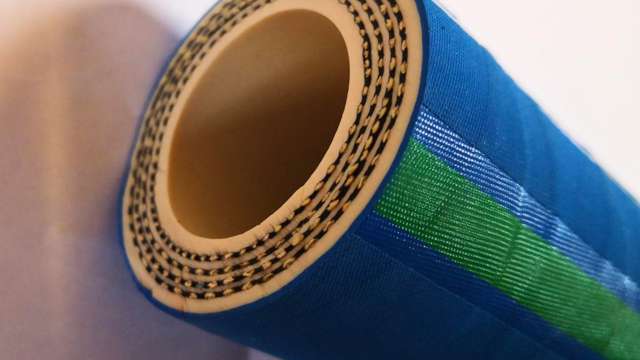
A hose is not ‘just’ a hose. It typically consists of several layers – inner rubber, reinforcement, outer rubber and coupling. Each layer must meet its own technical and regulatory requirements, and they must interact with the medium, pressure and temperature.
- Rubber hoses (elastomers): With rubber hoses, you must be able to demonstrate that they do not release harmful substances. Here, FDA 21 CFR 177.2600 is the key guideline for ensuring that the rubber does not release undesirable substances during testing.
- Plastic hoses (polymers): Subject to EU 10/2011, which requires specific migration testing at defined temperatures and contact times.
- Stainless steel fittings: Here, the focus is on EN 10204 3.1 certificates, which document the steel’s composition, test results and traceability.
Hoses and fittings are, in practice, the first and most overlooked line of defence against contamination. A single error in material selection can challenge even the best quality control.
| Component/material | Relevant regulations | What it means for you |
| Rubber hoses | FDA 21 CFR 177.2600, EU 1935/2004, EC 2023/2006 (GMP), possibly BfR recommendation |
Rubber must not release harmful substances and must be documented and traceable. |
| Plastic hoses | EU 10/2011, EU 1935/2004, EC 2023/2006 (GMP), FDA 21 CFR 177.1520 (olefin polymers), FDA 21 CFR 177.1550 (e.g. PTFE) |
Plastic must pass migration tests and have full documentation and traceability. |
| Stainless steel/fittings | EU 1935/2004, EC 2023/2006 (GMP), EN 10204 3.1 |
The composition and origin of the steel must be documented, and the design must be easy to clean. |
How to ensure full compliance – step by step
When putting together your next hose solution, it is advisable to follow these steps to ensure that documentation and safety are top-notch:
- Know your medium and your temperature: Start by identifying whether the medium is oily, acidic or contains alcohol. Temperature is crucial, as it dictates how the material reacts chemically and what specific documentation is required to prevent migration.
- Know your material: Remember that rubber, plastic and steel require different approvals.
- Verify traceability: Check that full documentation of the materials’ origin is available. You must be able to identify where the material comes from and where it is used in your supply chain.
- Check couplings: A hose consists of several layers. Be aware that each layer and the associated fittings must meet their own technical and regulatory requirements to work together under pressure. Here, the 3.1 certificate can be valuable.
Take control with a partner by your side
In the busy day-to-day of production, complex certifications and changing legal requirements can easily take a back seat. It's in these areas that constant attention is required, because the rules are constantly changing – and that's exactly where we can help you.
With our combination of component knowledge and insight into technical documentation, we can help you put together solutions that meet current requirements and standards right from the start.
Visit our compliance section to read more, or contact us directly by phone on +45 7020 0422 or via email at inquiry@alfotech.eu.